


I used to think consistency was one of the highest virtues—that if you believed something on Monday, you should believe the same thing on Friday, and changing your mind meant you were compromising, backsliding, or being deceived. Looking back, I realize how much energy I spent trying to stay the same, even when life was inviting me to grow.
I’ve lived enough lives now to know that growth almost always looks suspicious to people who aren’t growing in the same direction.
I was once absolutely certain about things I no longer believe. Not because I lacked sincerity, but because sincerity and accuracy aren’t the same thing. I wasn’t trying to deceive anyone. I was doing the best I could with the information, experiences, and fears I had at the time.
That’s true for all of us, whether we’re willing to admit it or not.
One of the more amusing parts of getting older is discovering that your younger self would probably argue with your current self—and lose spectacularly. At least I hope he would. Although, if I’m being honest, younger Randy had the confidence of a man who’d read three books and was prepared to explain the universe to anyone who accidentally made eye contact.
That last paragraph is cringe and chuckle-worthy all at once :)
These days I’m far less interested in winning arguments than I am in understanding people. That’s not because I’ve become soft. It’s because life has a remarkable way of sanding down the sharp edges of certainty.
I’ve buried people I loved. I’ve watched marriages thrive and others quietly unravel. I’ve celebrated extraordinary joy and sat beside heartbreaking grief. I’ve learned that real life stubbornly refuses to fit inside tidy theological systems, political slogans, or inspirational coffee mugs.
Experience has a way of humbling us—if we let it.
There was another lesson I learned the hard way.
When I came out, a lot of people were shocked. To them, it seemed like I’d changed overnight. They couldn’t understand how someone who had spent years in ministry and leadership could suddenly announce something that, in their minds, came out of nowhere.
What they didn’t know was that it hadn’t come out of nowhere. I’d spent several years wrestling with questions I wasn’t ready to share. Those years were lonely, painful, and often confusing. I kept that journey to myself because I already knew what many of my church family would say. I didn’t need to imagine their responses—I had spent enough of my life saying some of those same things to other people.
When I finally did come out, they said almost exactly what I expected. It hurt, but it didn’t surprise me. In an odd way, keeping my journey private had given me time to prepare for that moment. I wasn’t trying to deceive anyone. I was trying to survive long enough to tell the truth.
That experience taught me something I hope I never forget: when someone’s life seems to change overnight, it almost never has. You’re usually seeing the final chapter of a story they’ve been quietly living for a very long time.
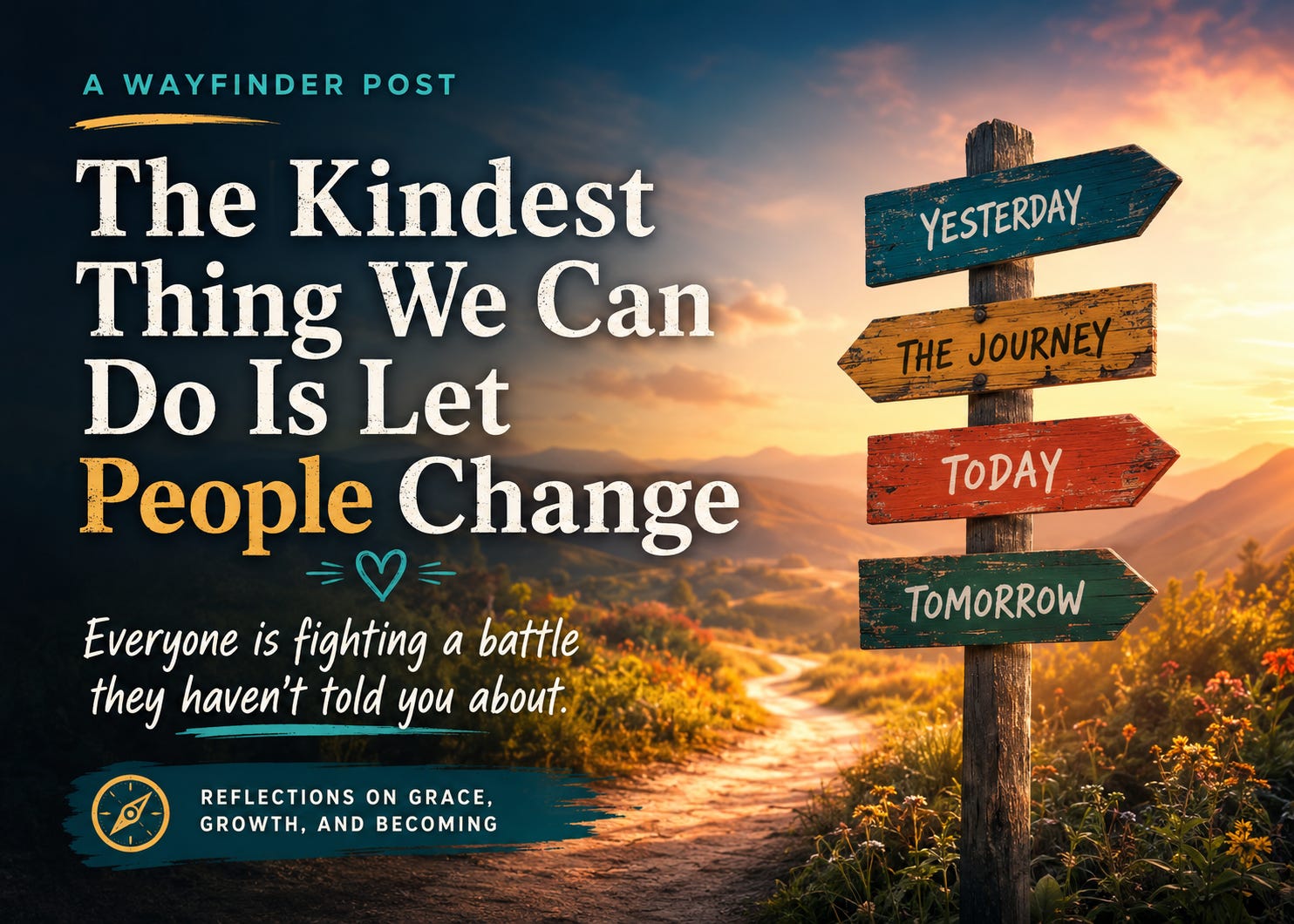
One of the greatest gifts we can give another person is permission to change.
Imagine how different our friendships, families, and communities would be if our first response to someone’s growth wasn’t, “But that’s not who you used to be.”
Well… I certainly hope not.
I don’t want my fifty-eight-year-old self to be trapped inside the worldview of my twenty-eight-year-old self. That wouldn’t be faithfulness. That would be emotional taxidermy.
And let’s be honest. None of us wants to be preserved like a mounted deer head hanging over someone’s fireplace. We were made to breathe, to wander, to question, and occasionally to discover we’ve been spectacularly wrong.
Preferably before posting about it on social media. #learnedthehardwayrepeatedly
Change isn’t always improvement. People can become more fearful, more cynical, or more rigid. Growth isn’t automatic just because the calendar keeps flipping.
But healthy change usually leaves clues. It produces more compassion than condemnation. More curiosity than certainty. More peace than performance.
I’ve found that the people who are most comfortable allowing others to evolve are usually the ones who’ve given themselves permission to do the same. They know what it costs to rethink old assumptions. They understand the courage it takes to apologize, to learn, and sometimes to begin again.
Maybe that’s why grace matters so much.
Grace isn’t pretending our past didn’t happen. It’s refusing to chain someone to it forever.
I don’t expect everyone to agree with who I’ve become. Frankly, there are days I’m still getting acquainted with him myself. But I hope I’ve become someone who’s quicker to listen, slower to judge, and much more willing to admit when I don’t know something.
That feels less like losing my convictions and more like finally growing into them.
If someone in your life is changing, resist the urge to freeze them in an old photograph. Get curious instead. Ask questions. Listen to their story. You may not end up agreeing with every conclusion they reach, but you’ll probably understand them better.
And if you’re the one who’s changing, don’t apologize simply because your journey makes someone else uncomfortable.
We’re supposed to change. Trees do it. Rivers do it. Caterpillars have built an entire public relations campaign around it.
Maybe becoming isn’t a betrayal of who we were.
Maybe it’s exactly what we were created for.
Life is weird, people are complicated, and apparently I have a lot to say about both. Subscribe (free or paid) and I’ll deliver fresh stories, reflections, and the occasional bad joke straight to your inbox—saving you from having to remember to check Substack yourself.