


Couldn’t even wait two weeks after July 4th, our 250th birthday and we gotta get all twisted in a knot about someone dying? Of course! America loves a spectacle — even in death. The moment Lindsey Graham’s passing hit the news, the internet lit up like a stadium: half mourning, half mocking, everyone convinced their reaction was righteous. And honestly? I get it. The man spent decades weaponizing policy against people like me. He earned the contempt. But still — I couldn’t join the victory lap whole heartedly (even though some of the memes made me chuckle).
I couldn’t stand him. I detested his politics. I found his moral flexibility nauseating. He was the kind of man who could look straight into a camera, lie through his teeth, and still get invited back to Sunday morning shows. So when he died, I understood the catharsis. I understood the memes. I even understood the laughter. But I couldn’t participate.
Not because I’m noble. Not because I’m forgiving. Because celebrating the death of a sitting US Senator feels like bad patriotism — the kind that confuses vengeance for virtue.
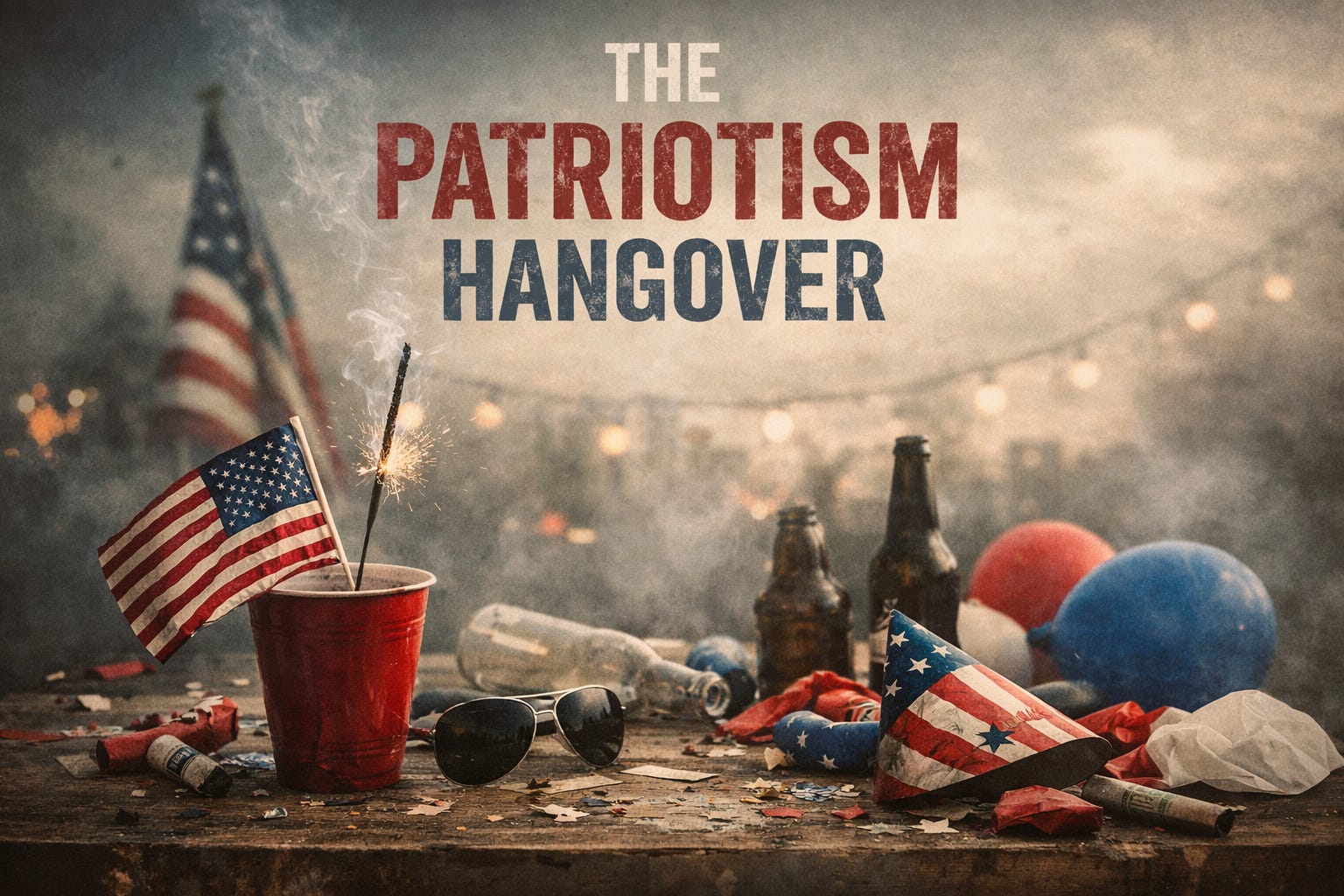
Yeah, I know. I’m the old guy, standing on my lawn the neighbor kids CAN play on holding my sparkler, waving my flag, sipping some spiked lemonade while reciting the bill of rights...
I can’t rejoice in the death of the wicked without feeling like I’ve betrayed the version of America I still, somehow, believe in. The one that’s supposed to be better than its worst instincts. The one that’s supposed to hold space for accountability without losing its humanity.
And that belief — fragile, bruised, stubborn — is the only kind of patriotism I have left.
Let’s be clear: I’m not defending him. I’m not rewriting history. Lindsey Graham’s legacy is a masterclass in hypocrisy. He spent years enabling cruelty, then tried to rebrand it as “principle.” He helped build a political machine that chews up truth and spits out grievance. He made life harder for people who were already fighting to exist.
So no, I don’t mourn him. But I also don’t dance on his grave. Because the minute I start celebrating death, I start mirroring the same moral rot I’ve spent years calling out.
That’s the hangover — the one that hits after the fireworks fade and the hashtags die down. The realization that patriotism isn’t necessarily about loving the flag; it’s about refusing to become the monster you fought.
And listen, I’m not judging anyone who did celebrate. Some folks have every right to feel relief. Some have scars that never healed. Their reactions are theirs. Their patriotism, whatever that looks like, is theirs. I don’t get to police that.
But mine? Mine’s wired differently. It’s stitched together from too many nights spent believing this country could still grow up. It’s the kind that whispers, “Don’t lose yourself just because everyone else is doing their thing.”
Now, will I maintain this moral clarity when Trump eventually goes?
Let’s not kid ourselves. My patriotism might need a sabbatical that day. F**k Resident Clump. But even then, I suspect I’ll land in the same place — relieved, not gleeful… well … not totally gleeful ;). Because I don’t want to become the thing I escaped.
Patriotism, for me, is restraint in a culture that rewards rage.
It’s refusing to trade integrity for applause.
It’s believing that America can still be redeemed — even when its loudest voices make that belief feel naïve.
Welcome to Mugwump Ramblings, where once a week I’m untangling decades of religious trauma, the next I’m laughing at myself, and somehow it all ends with coffee.
If you’ve ever felt like a ping-pong ball in a dryer, you’ll fit right in.
Come subscribe (free or paid). We have stories, questionable life choices, and occasional moments of unexpected grace.