

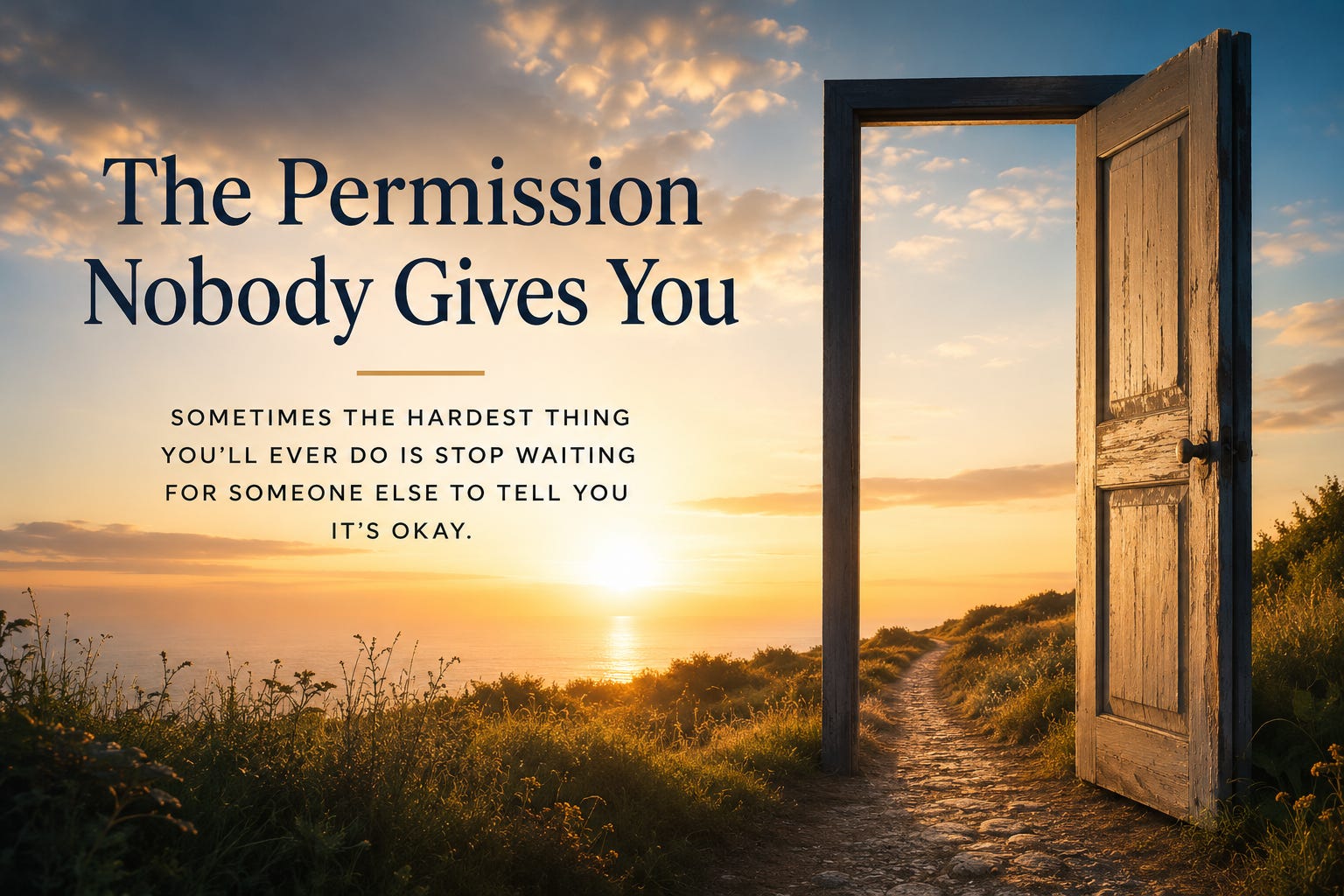
I spent a surprising amount of my life waiting for permission.
Not permission to do something reckless or irresponsible. I was waiting for permission to ask questions. Permission to admit I didn’t know. Permission to change my mind. Permission to disappoint people I loved. Permission to leave places that no longer fit. Most of all, I was waiting for permission to become the person I was slowly discovering I already was.
The strange thing is that I honestly believed someone else would eventually grant it. A pastor. A mentor. A therapist. A parent. Maybe even God. Surely, if I prayed hard enough or proved myself faithful enough, someone would finally look me in the eye and say, “It’s okay. You can live your life now.”
That moment never came.
I grew up believing maturity meant becoming more certain. The people I admired seemed so confident. They had answers for every question and convictions about everything that mattered. Doubt was given lip-service but wasn’t really considered part of a healthy faith; it was usually treated as evidence that something was wrong with you. If your beliefs were solid enough and your commitment deep enough, certainty was supposed to follow.
When it didn’t, I assumed the problem was me.
That belief followed me into adulthood and eventually into my work at Exodus International. Looking back, I can see I wasn’t just trying to do my job well. I was trying to earn approval from everyone who mattered. I wanted pastors to approve of me. I wanted donors to approve of me. I wanted board members, fellow leaders, and the broader evangelical world to see me as faithful, trustworthy, and “healed.” I wasn’t simply working; I was performing, constantly trying to prove that I belonged.
I don’t think I realized how exhausting that performance had become until my mind and body finally refused to cooperate.
The pressure eventually drove me back into counseling for the third time in my life. It was there that I received a diagnosis I never expected: complex PTSD.
At first, it made no sense to me. Complex PTSD was something soldiers experienced. Survivors of war. Survivors of horrific accidents. I hadn’t been through anything like that—or so I thought.
My counselor helped me understand something I had never considered. Trauma isn’t always the result of one (or more) catastrophic event. Sometimes it also accumulates over years of living in fear, shame, hypervigilance, and the constant pressure to be someone other than yourself. I had become so focused on earning approval that I had almost completely lost sight of the person God created me to be.
That diagnosis didn’t magically heal me, but it gave me language for an exhaustion I had never been able to explain. It also quietly changed the question I was asking. Instead of wondering how I could earn everyone’s approval, I began wondering whether I had been living for the wrong audience all along.
I don’t blame the people who were part of that chapter anymore. Most of them genuinely believed they were helping me. Many of them loved me. They were living out the beliefs they sincerely held, just as I was living out mine.
But somewhere along the way, I stopped asking them to write my life story.
That became even more important during the years leading up to my coming out. People are sometimes surprised to learn that I wrestled with my sexuality privately for several years before saying anything publicly. I didn’t share that journey with many people in my church world because I already knew what most of them would say. I could practically quote the conversations before they happened. I knew which Bible verses would be mentioned, which warnings would be offered, and how disappointed people would be.
When I finally came out, many people responded exactly the way I expected.
It hurt, but it also brought an unexpected kind of freedom. After years of fearing other people’s reactions, I realized I had survived them. The catastrophe I had imagined never arrived. Relationships changed. Some ended. Others deepened. My life became more complicated in some ways and much simpler in others.
The fear had been carrying more weight than reality ever did.
I’ve noticed that almost every meaningful change in my life has disappointed someone. Leaving ministry disappointed people. Changing my theology disappointed people. Coming out disappointed people. Even today, my husband and I continue discovering that marriage isn’t something you finish figuring out. Like every healthy relationship, it keeps inviting us to grow. We aren’t questioning our commitment to each other, but we are learning that authenticity sometimes asks different questions than certainty ever allowed.
I’ve slowly come to believe that living honestly and pleasing everyone have always been mutually exclusive goals.
That doesn’t mean we should become careless with people. Kindness still matters. Listening still matters. Humility still matters. I hope those qualities continue growing in me for the rest of my life.
But I’ve also learned that making other people’s comfort the measure of my faithfulness is a burden I was never meant to carry.
One of the unexpected gifts of getting older is discovering that the adults who seemed to have everything figured out were improvising far more than I realized. I’m approaching sixty now, and I can let you in on a secret: most of us are making the best decisions we can with the understanding we have at the time. Some people simply look more confident while they’re doing it.
Oddly enough, I find that comforting.
It reminds me that I’m still allowed to learn. I’m still allowed to change my mind. I’m still allowed to apologize when I’m wrong. I’m still allowed to grow into someone my younger self couldn’t have imagined without feeling obligated to defend every version of who I used to be.
These days, friends often come to me looking for advice. They tell me about careers they’re questioning, relationships they’re trying to understand, churches they’re thinking about leaving, or dreams they’re afraid to pursue. The older I get, the more I realize that most people aren’t really asking me what they should do.
They’re asking whether it’s okay.
Sometimes I can reassure them. Sometimes I can offer perspective. But I also know that my permission isn’t the permission they’re ultimately looking for.
Sooner or later, each of us reaches a point where we have to sign our own permission slip.
Not recklessly. Not selfishly. Not without listening carefully to wise people who have earned the right to speak into our lives. But with the quiet confidence that this one extraordinary, complicated, unrepeatable life is ours to live.
There will always be people who are more comfortable with the old version of you than the person you’re becoming. There will always be voices insisting that growth is betrayal or that changing your mind is weakness. If you wait for unanimous approval before becoming who you’re meant to be, you’ll spend your entire life waiting.
I know.
I did.
And if you’ve been sitting on the edge of a decision, hoping someone else will finally tell you it’s okay to ask the hard questions, to begin counseling, to leave what is crushing your spirit, to heal, to start over, or simply to become more fully yourself, let me save you a few years.
The permission you’ve been waiting for was never theirs to give.
It has been yours all along.
Life is weird, people are complicated, and apparently I have a lot to say about both. Subscribe (free or paid) and I’ll deliver fresh stories, reflections, and the occasional bad joke straight to your inbox—saving you from having to remember to check Substack yourself :).
That is some important wisdom!