

If you haven’t read Matthew Vines’ recent guest essay in The New York Times, it’s worth reading before you read my response:
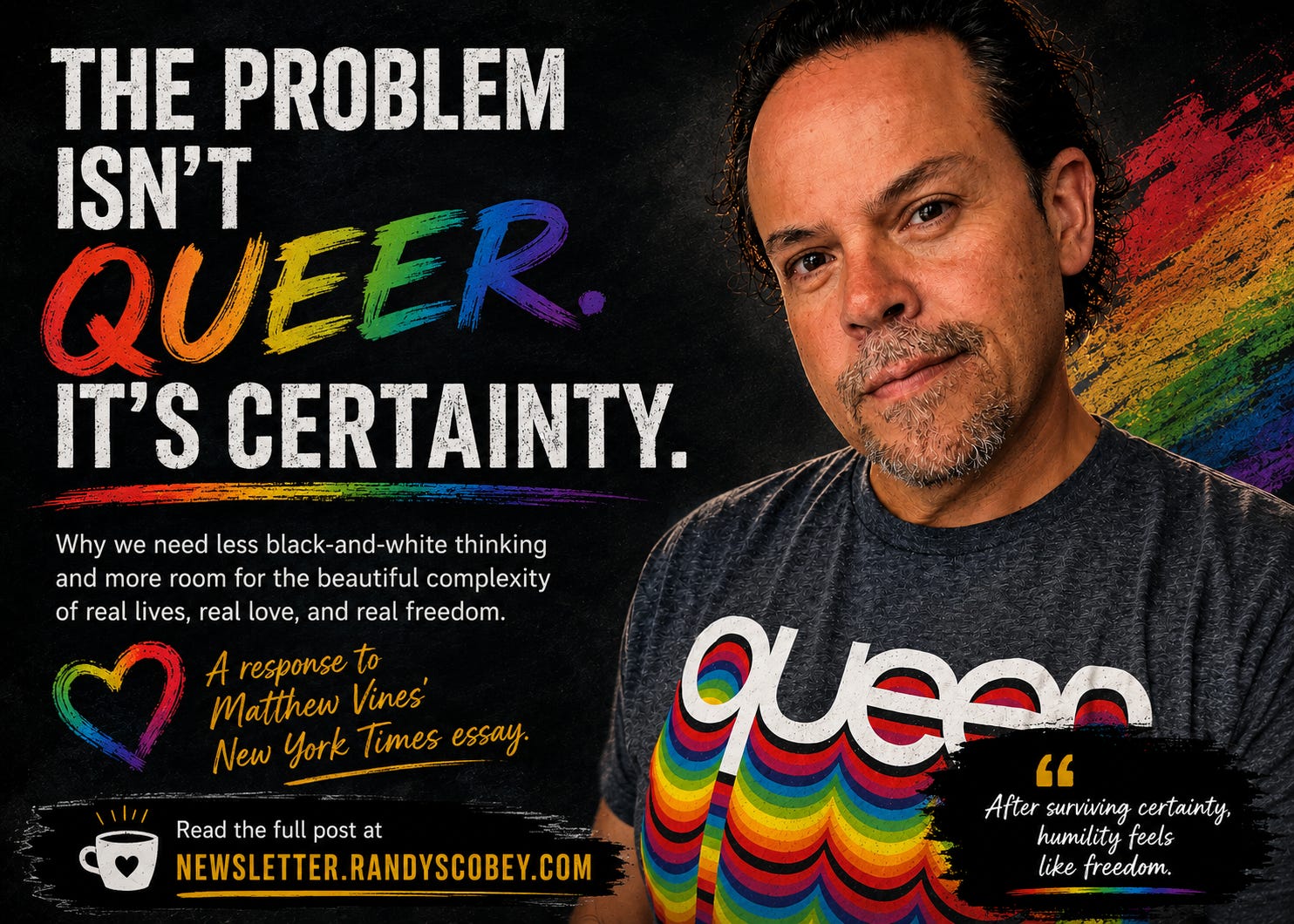
Original article: Matthew Vines: “Queer Politics Has Failed Gay People”
Matthew Vines’ essay argues for a vision of gay identity that is more familiar, more stable, and ultimately more acceptable to the broader culture. I understand the instinct. We’ve spent decades trying to convince our neighbors that we’re not so different after all.
But I couldn’t shake the feeling that I was reading a different version of the Christian legalism many of us spent years trying to escape.
Legalism doesn’t always sound religious.
Sometimes it simply sounds certain.
One of the lasting wounds from my years in the ex-gay movement wasn’t just being told what to believe. It was being told there was one correct way to understand complex human experiences. Every question had a definitive answer. Every gray area had to become black or white. Every mystery had to be solved before anyone could belong.
I hear echoes of that certainty whenever someone insists they’ve discovered the “mature,” “healthy,” or even “biblical” way to be gay.
Matthew Vines has spent years making the biblical case that loving, committed same-sex relationships are consistent with Scripture. I respect the courage it took to challenge the theology many of us inherited, and I know his work has been life-giving for countless people; including myself.
But in reading his latest essay, I found myself wondering whether the framework itself has changed as much as the conclusions. While he rejects conservative answers, he still seems to be searching for the correct Christian model—the faithful pattern against which other expressions of LGBTQ+ relationships are measured.
That’s the part that gives me pause.
Having spent years inside evangelical Christianity, I’ve grown wary anytime someone claims to have finally discovered God’s blueprint for complicated human lives. I don’t care whether the conclusion is conservative or progressive. The instinct feels familiar.
It’s the instinct that says, “We’ve finally gotten the interpretation right.”
To me, that’s simply another form of Christian legalism.
Legalism isn’t defined by the conclusions it reaches. It’s defined by the confidence that there is one divinely sanctioned answer for everyone—and that faithful people should all arrive there.
The irony is that many LGBTQ+ people fought for the freedom to escape rigid categories, only to find ourselves creating new ones.
I don’t particularly care whether someone calls themselves gay, queer, lesbian, bisexual, or something else entirely. Those words are useful until they aren’t. They help us communicate, but they should never become fences that define who belongs and who doesn’t. Language evolves because people evolve.
What concerns me more is the assumption that there is one ideal expression of LGBTQ+ relationships.
For centuries, marriage itself has been anything but static. It has been economic, political, patriarchal, romantic, egalitarian, sacramental, contractual, and countless combinations in between. Even heterosexual marriage has changed dramatically over the last hundred years.
So why, after finally winning the right to marry, would we assume there is only one acceptable model for gay marriage?
That question isn’t theoretical for me.
My husband and I are living in that in-between space ourselves. We aren’t questioning our marriage. We aren’t questioning our commitment to each other. If anything, we’re more committed than we’ve ever been.
What we’re questioning are some of the assumptions we inherited about what marriage is supposed to look like—assumptions shaped as much by modern Western culture and patriarchal traditions as by any timeless understanding of love and commitment. We’re discovering that building a healthy marriage may require more curiosity than conformity.
I don’t have neat answers yet. In fact, I’m intentionally resisting the urge to have them.
We’re in the middle of a conversation about what expressions of marriage and sexuality help us become healthier individuals and a healthier couple. It’s still very much a work in progress. Frankly, I think that’s exactly where growth happens—not in certainty, but in curiosity.
Don’t worry. This isn’t the prelude to an announcement. It’s simply a growth opportunity for both of us, and one we’re navigating together with honesty, respect, and a great deal of love.
Maybe that’s why I found myself pushing back against Matthew’s essay. I appreciate his desire to ground LGBTQ+ relationships in Christian faithfulness. I simply no longer believe there is one biblically prescribed template for healthy gay relationships—or for healthy marriages in general.
I’m living proof that real marriages don’t always fit tidy categories. They evolve. They ask new questions. They invite us to keep learning about ourselves and each other.
The moment we begin insisting there’s one faithful pattern that everyone should follow, I worry we’ve wandered back into the same certainty that wounded so many of us in the first place.
Some couples embrace traditional roles. Others intentionally reject them. Some structure their relationships around strict monogamy, others around negotiated openness, and many find themselves somewhere in between. Healthy relationships aren’t measured by how closely they resemble a mid-century suburban ideal. They’re measured by honesty, mutual care, consent, and the ability to flourish together.
Too often our public conversations reduce these questions to binaries: respectable versus radical, gay versus queer, traditional versus progressive. Real life refuses to cooperate with those categories.
Perhaps that’s because human beings are wonderfully untidy.
I’ve become increasingly suspicious of anyone—including myself—who claims too much certainty about how other people should build meaningful lives. The older I get, the more convinced I am that humility is a better guide than certainty.
I spent enough years believing God had handed us an instruction manual for every complicated question. Experience taught me otherwise.
Maybe the healthiest communities aren’t the ones that agree on every definition or every model of marriage. Maybe they’re the ones spacious enough to admit that faithful, loving, flourishing lives can take more than one shape.
That isn’t moral confusion.
It’s intellectual humility.
For most of my life, I confused certainty with faithfulness.
Today, I suspect humility may be the more faithful posture.
I don’t know exactly what the future of marriage will look like—for straight couples, for gay couples, or even for my own. I’m finally okay admitting that.
After surviving certainty, humility feels like freedom.
I can’t promise answers, but I can promise questions worth wrestling with, stories that occasionally make people laugh, and the occasional sacred cow wandering into traffic. Subscribe free or paid and join the conversation.
Yes, yes, YES! To everything you said!
I was completely turned off to Matthew Vines article. It immediately made me feel repulsed inside and I know it's because of his desire to fit everything into a spiritual box. I just can't deal with spiritual narcissism anymore because there is no one way to life. To me, Vines feels like he is still trying to fit into some kind of Evangelical mold...maybe "Evangelical Lite". I just can't. His message has become just as toxic as the "Side B" crew. It's a big "no" for me and his theology is toxic to our community as a whole.
Good job for the further explorations you and your husband have embarked on. I believe that to be very healthy!